
 Available in US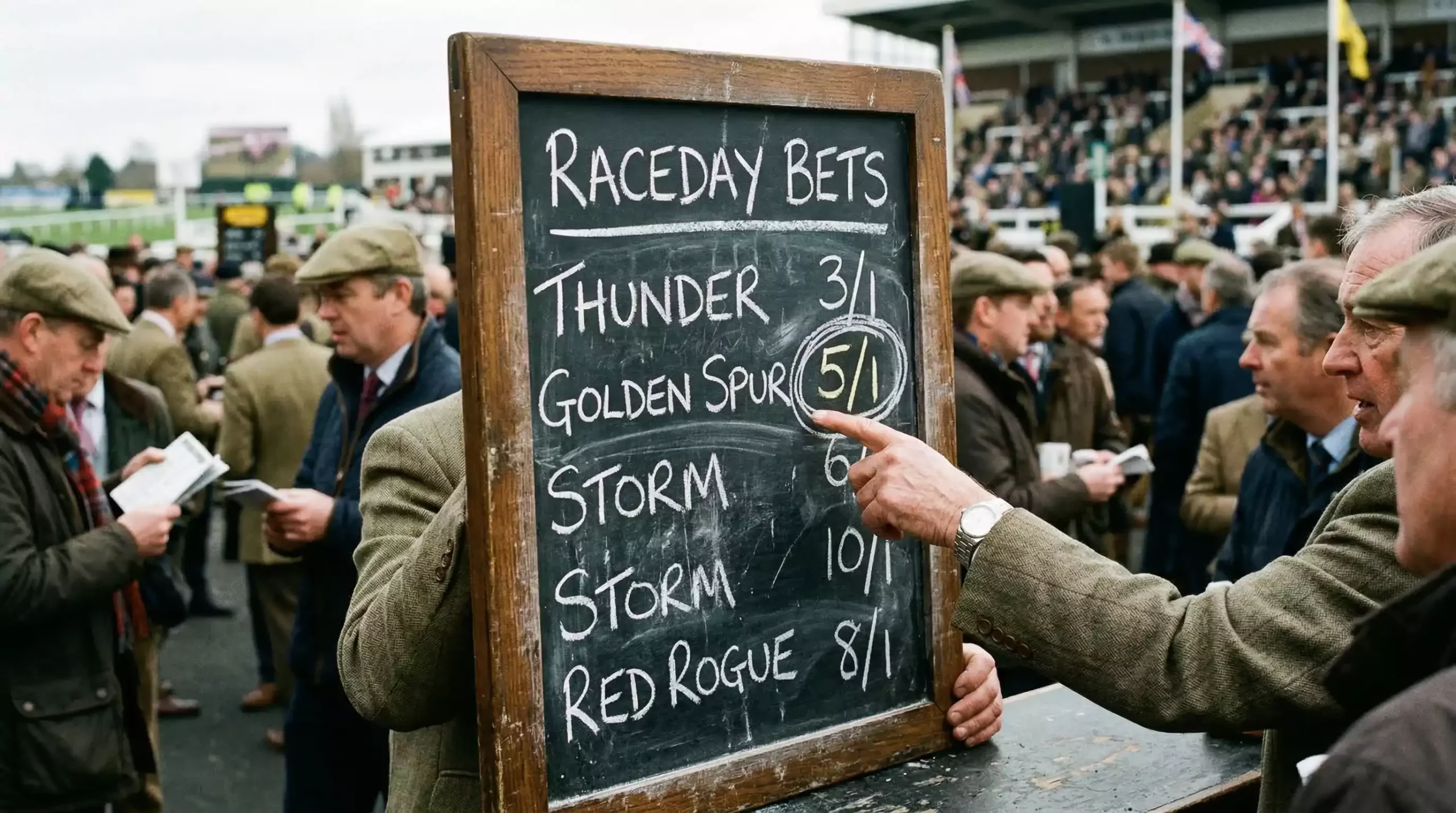
Every set of betting odds implies a probability. When a bookmaker prices a horse at 4/1, they are implicitly stating that horse has roughly a 20% chance of winning. Understanding what the odds really mean helps you assess whether prices represent value or whether the bookmaker’s assessment exceeds your own.
Implied probability converts odds into percentages that you can compare against your own win estimates. If you believe a horse has a 30% chance but the bookmaker’s odds imply only 20%, you have identified potential value. Conversely, if you think 15% while the odds imply 20%, the bookmaker rates the horse more highly than you do.
The Gambling Commission reported total UK gambling gross gaming yield of £15.6 billion between April 2023 and March 2024, with online sports betting contributing £565 million in GGY during Q4 2024 alone. Within this massive market, punters who understand implied probability gain analytical advantage over those who simply chase attractive-looking prices without understanding what those prices mean.
Implied Probability Calculator — More on this topic at horse racing bet calculator.
Implied Probability Formula
The core formula for implied probability is: Implied Probability = 1 / Decimal Odds. This simple division converts any price into its equivalent percentage chance. A horse at decimal odds of 5.0 has implied probability of 1/5.0 = 0.20, or 20%.
The formula assumes a fair market with no bookmaker margin. In reality, bookmakers build profit margins into their odds, meaning the implied probabilities of all runners in a race sum to more than 100%. This excess represents the overround or vig that ensures bookmaker profit.
For fractional odds, convert to decimal first: Decimal Odds = (Numerator / Denominator) + 1. So 4/1 becomes (4/1) + 1 = 5.0. Then apply the implied probability formula: 1/5.0 = 20%. Alternatively, use the direct fractional formula: Implied Probability = Denominator / (Numerator + Denominator). For 4/1: 1/(4+1) = 1/5 = 20%.
Odds-on prices work identically. A horse at 1/2 (decimal 1.5) has implied probability of 1/1.5 = 0.667, or 66.7%. The market considers this horse highly likely to win. A horse at 1/4 (decimal 1.25) implies 80% probability, making it a strong favourite.
Comparing implied probability across bookmakers reveals pricing discrepancies. If one bookmaker offers 4/1 (20% implied) and another offers 9/2 (18.2% implied), the second bookmaker rates the horse less likely to win, offering better value for punters who disagree with that assessment.
Fractional Odds to Probability
Fractional odds express potential profit relative to stake. At 5/1, you profit £5 for every £1 staked if successful. Converting to implied probability requires recognising that the denominator represents successful outcomes while the sum represents all outcomes.
The formula: Implied Probability = Denominator / (Numerator + Denominator). At 5/1, this gives 1 / (5+1) = 1/6 = 16.67%. At 3/1, it gives 1 / (3+1) = 1/4 = 25%. At evens (1/1), it gives 1 / (1+1) = 1/2 = 50%.
Non-standard fractional odds follow the same logic. At 11/4, implied probability is 4 / (11+4) = 4/15 = 26.67%. At 9/4, it is 4 / (9+4) = 4/13 = 30.77%. These less intuitive fractions are common in racing, making calculation skills valuable.
Odds-on fractional prices reverse the pattern. At 1/2, implied probability is 2 / (1+2) = 2/3 = 66.67%. At 4/9, it is 9 / (4+9) = 9/13 = 69.23%. The higher the denominator relative to numerator, the greater the implied probability.
Mental shortcuts help with common prices. 4/1 implies 20%. 9/2 implies about 18%. 7/2 implies about 22%. 5/2 implies about 29%. 6/4 implies 40%. Memorising these common conversions speeds up race card assessment without needing constant calculation.
Decimal Odds to Probability
Decimal odds simplify implied probability calculation because the formula is simply division: 1 / Decimal Odds = Implied Probability. Betting exchanges use decimal odds precisely because this mathematical clarity suits their trading-focused users.
At decimal odds of 4.0, implied probability is 1/4.0 = 0.25 = 25%. At 2.5, it is 1/2.5 = 0.40 = 40%. At 10.0, it is 1/10.0 = 0.10 = 10%. The calculation requires only basic division, making decimal odds analytically convenient.
Decimal odds include your returned stake, unlike fractional odds which show profit only. Decimal 4.0 means you receive £4 total for each £1 staked, including your stake back. This is equivalent to 3/1 fractional, where you profit £3 plus receive your £1 stake. Understanding this distinction prevents confusion when comparing formats.
Very short decimal odds indicate high implied probability. Decimal 1.10 implies 1/1.10 = 90.9% probability. Decimal 1.05 implies 95.2%. These extremely short prices leave little room for error; the market considers these outcomes near-certain.
Very long decimal odds indicate low implied probability. Decimal 51.0 implies just 1.96%. Decimal 101.0 implies less than 1%. These are the rank outsiders that rarely feature in serious betting considerations but occasionally produce memorable upsets.
Removing Bookmaker Margin
Bookmaker odds include built-in margins that inflate implied probabilities beyond 100%. In a two-horse race with true 50/50 chances, a fair market would offer evens on both. Bookmakers might instead offer 10/11 on both, implying 52.4% each, totalling 104.8%. That 4.8% excess is the overround or margin.
To find true implied probability, calculate each selection’s raw implied probability, sum them all, then divide each by the total. This normalises probabilities to sum to 100%, removing the bookmaker’s margin.
Example: A three-horse race offers 2/1, 3/1, and 5/1. Raw implied probabilities: 33.3%, 25%, and 16.7%, totalling 75%. This suggests value exists since probabilities should sum to at least 100%. In practice, bookmaker markets always exceed 100%.
Realistic example: Odds of 6/4 (40%), 3/1 (25%), 4/1 (20%), and 8/1 (11.1%) total 96.1%. Oddly low, but some competitive markets approach fair. Typically, overrounds range from 105% to 120% depending on market and bookmaker. Exchanges offer tighter margins, sometimes under 102%.
Identifying markets with lower overround helps find value. Compare total implied probability across bookmakers on the same race. Lower totals mean better prices somewhere in the market.
Using the Calculator
Our implied probability calculator accepts odds in fractional or decimal format and instantly displays the corresponding percentage probability. Enter any odds, and the calculator shows what win chance the bookmaker’s pricing implies.
The calculator handles both simple and complex fractional odds. Enter 5/1 or 11/4 or 100/30, and the calculator converts each to implied probability. For decimal odds, simply enter the figure directly. Results display as percentages for easy comparison.
Use the multi-runner mode to analyse entire race markets. Enter odds for all runners, and the calculator displays individual implied probabilities plus the market total. Totals exceeding 100% reveal the bookmaker’s overround, while totals below 100% (rare) suggest potential value somewhere in the field.
Compare your probability estimates against the calculator’s output. If you assess a horse at 30% win chance but implied probability shows 20%, you have found potential value. If you assess 15% but implied shows 25%, the market rates the horse more highly than you do.
The calculator also shows probability ranges for each way betting, calculating both win implied probability and place implied probability based on your specified place terms. This comprehensive view helps assess total each way value before committing stakes.
See also Fractional Odds Explained.
