 Available in US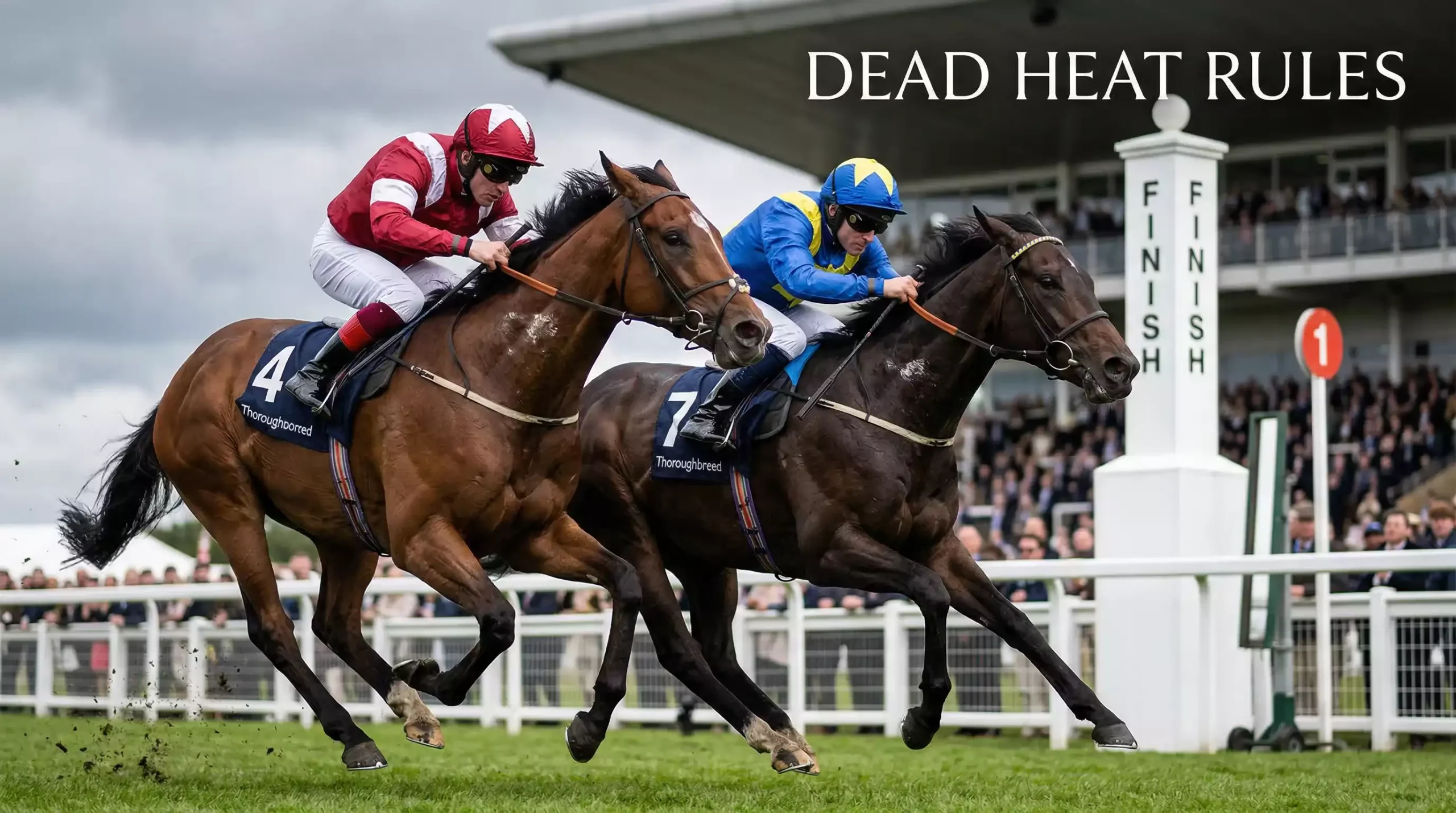
A dead heat in horse racing occurs when two or more horses cross the finish line at exactly the same moment, making it impossible for the judge to separate them. While modern photo-finish technology has reduced these situations, they still happen regularly in British racing, particularly when horses are competing for the minor places rather than first position.
Understanding dead heat rules matters because they directly affect your returns. When your selection finishes in a dead heat, the bookmaker applies a specific calculation that reduces your payout proportionally. This applies whether you backed the horse to win outright, for a place, or as part of an each way bet. The principle is straightforward: your stake gets divided by the number of horses involved in the dead heat, then multiplied by the full odds. A two-way dead heat means half your stake is settled at full odds, while the other half is treated as a loser.
Racecourse attendance reached 5.031 million in 2025, the highest figure since 2019 according to the British Horseracing Authority. With more people watching live racing and placing bets, knowing how divided returns work becomes essential for any serious punter.
Dead Heat Rules in Horse Racing — More on this topic at horse racing bet calculator.
When Dead Heats Occur
Dead heats happen more often than most casual punters realise. In 2024, British racecourses hosted 1,468 fixtures, and across thousands of individual races, a significant number produced dead heats for first, second, or third place. The situation typically arises in tight finishes where horses are separated by margins smaller than what even advanced timing equipment can reliably distinguish.
Photo-finish cameras capture images at intervals measured in thousandths of a second. When the camera cannot determine a clear winner, the judge declares a dead heat. This happens most frequently in large-field handicaps where horses of similar ability compete under conditions designed to produce close finishes. Jump racing sees fewer dead heats than flat racing because the wider margins created by obstacles tend to separate horses more definitively.
A dead heat can involve just two horses, but three-way or even four-way dead heats do occur. The more horses involved, the greater the reduction to your payout. Your betting slip remains valid regardless of the dead heat outcome. The bookmaker handles the adjustment automatically, settling your bet at the reduced rate. Some punters check the official result before realising their horse finished in a dead heat, particularly when watching races without commentary.
Dead heats for places matter just as much as dead heats for first. If three horses dead heat for second place, each occupies second, third, and a share of fourth simultaneously. This affects each way bets significantly, as we will examine in later sections.
Dead Heat Calculation Formula
The dead heat calculation follows a simple principle: divide your stake by the number of horses sharing the position, then calculate returns on that reduced stake at full odds. The formula looks like this: Adjusted Stake = Original Stake ÷ Number of Horses in Dead Heat. You then multiply the adjusted stake by your odds to find your winnings.
Consider a £10 bet at 5/1 where your horse finishes in a two-way dead heat for first place. Your adjusted stake becomes £10 ÷ 2 = £5. At 5/1, that £5 returns £25 plus your £5 stake back, giving you £30 total. Had the horse won outright, you would have received £60. The other £5 of your original stake is treated as a losing bet.
With three horses in a dead heat, the division becomes more severe. That same £10 bet at 5/1 now uses an adjusted stake of £10 ÷ 3 = £3.33. Your returns work out to approximately £16.65 plus your £3.33 stake, totalling around £20. Two-thirds of your original stake effectively loses.
The bookmaker applies this calculation automatically. You will see the adjustment reflected in your settled bet history, usually with a note indicating dead heat deductions applied. Online accounts typically show both the original potential payout and the actual settled amount. For accumulator bets involving a dead heat selection, the reduced return carries forward to the next leg, compounding the overall reduction in your final payout.
Understanding this formula helps you appreciate why some punters avoid betting on likely dead heat scenarios, such as tight handicaps with multiple horses of similar ability. The mathematics simply does not favour you when positions get shared.
Dead Heat in Place Bets
Place betting creates additional complexity when dead heats occur. A dead heat for second place can create peculiar situations where your horse simultaneously finishes second and third, or even occupies second, third, and fourth together if three horses cannot be separated.
Suppose you placed a bet on Horse A to finish in the top three. Two horses dead heat for second place. Your horse is one of them. In this scenario, Horse A finishes both second and third. Since both positions fall within the place terms, your bet wins in full. The dead heat only affects horses that straddle the place boundary.
The tricky situations arise when the dead heat spans the cutoff point. Imagine three horses dead heat for third place in a race paying three places. Your selection technically finishes third, fourth, and fifth simultaneously. Since only one of those three positions counts as a place, your bet gets reduced. The bookmaker divides your stake by three because your horse occupies one paying position out of three shared positions.
Larger fields paying more places reduce the frequency of these boundary dead heats. The Grand National, paying six or even more places depending on bookmaker offers, gives you more breathing room. A dead heat for sixth position still results in reductions if it spills into seventh, but the extra places mean fewer situations where this affects you directly.
Dead Heat in Each Way Bets
Each way bets involve two separate wagers: one for the win, one for the place. When a dead heat occurs, the bookmaker applies the reduction to whichever portion is affected, or sometimes to both if your horse dead heats for first place.
A dead heat for first place triggers adjustments to both the win and place parts of your each way bet. Your horse has won, so the win portion pays out, but at the reduced rate. The place portion also pays because the winner always counts as having placed. However, since the horse dead heated for first, the place portion also gets reduced by the same factor. A two-way dead heat for first means both your win and place bets are settled at half stakes.
When the dead heat occurs for a place position rather than first, only the place portion of your bet is affected. Say you backed a horse each way at 10/1 with 1/4 odds for the place. The horse finishes outright third in a race paying three places, but dead heats with another horse for that third position. Your win bet loses entirely because the horse did not win. Your place bet faces a two-way dead heat, so half your place stake pays at 10/4 (which equals 5/2) while the other half loses.
Calculating these returns manually requires attention to each component. Fortunately, dead heat calculators handle the mathematics automatically, showing you exactly what to expect when divided returns apply to each way bets.
Examples with Numbers
Let us work through several practical scenarios to demonstrate dead heat calculations in action.
Example 1: Win bet, two-way dead heat. You place £20 on a horse at 7/2 to win. The horse dead heats for first with one other runner. Your adjusted stake is £20 ÷ 2 = £10. At 7/2, that £10 returns £35 profit plus your £10 stake = £45. Had the horse won outright, you would have collected £90. The dead heat costs you £45.
Example 2: Place bet, three-way dead heat across the boundary. You bet £15 on a horse to place at 6/1 in a race paying three places at 1/4 odds. Your horse finishes in a three-way dead heat for third, meaning it occupies third, fourth, and fifth. The place odds are 6/4 = 1.5/1. Your adjusted stake is £15 ÷ 3 = £5 because only one of the three shared positions pays. That £5 at 1.5/1 returns £7.50 profit plus your £5 stake = £12.50 total.
Example 3: Each way bet, dead heat for first. You stake £10 each way on a horse at 8/1, paying 1/5 odds for places. Total stake is £20. The horse dead heats for first with one other runner. Win portion: £10 ÷ 2 = £5 at 8/1 = £40 profit plus £5 stake = £45. Place portion: £10 ÷ 2 = £5 at 8/5 = £8 profit plus £5 stake = £13. Total return: £45 + £13 = £58. Without the dead heat, you would have received £90 (win) + £26 (place) = £116.
These examples illustrate why experienced punters factor dead heat risk into their staking decisions, particularly in competitive races where multiple horses have similar chances.
See also Yankee Bet Calculator.
