 Available in US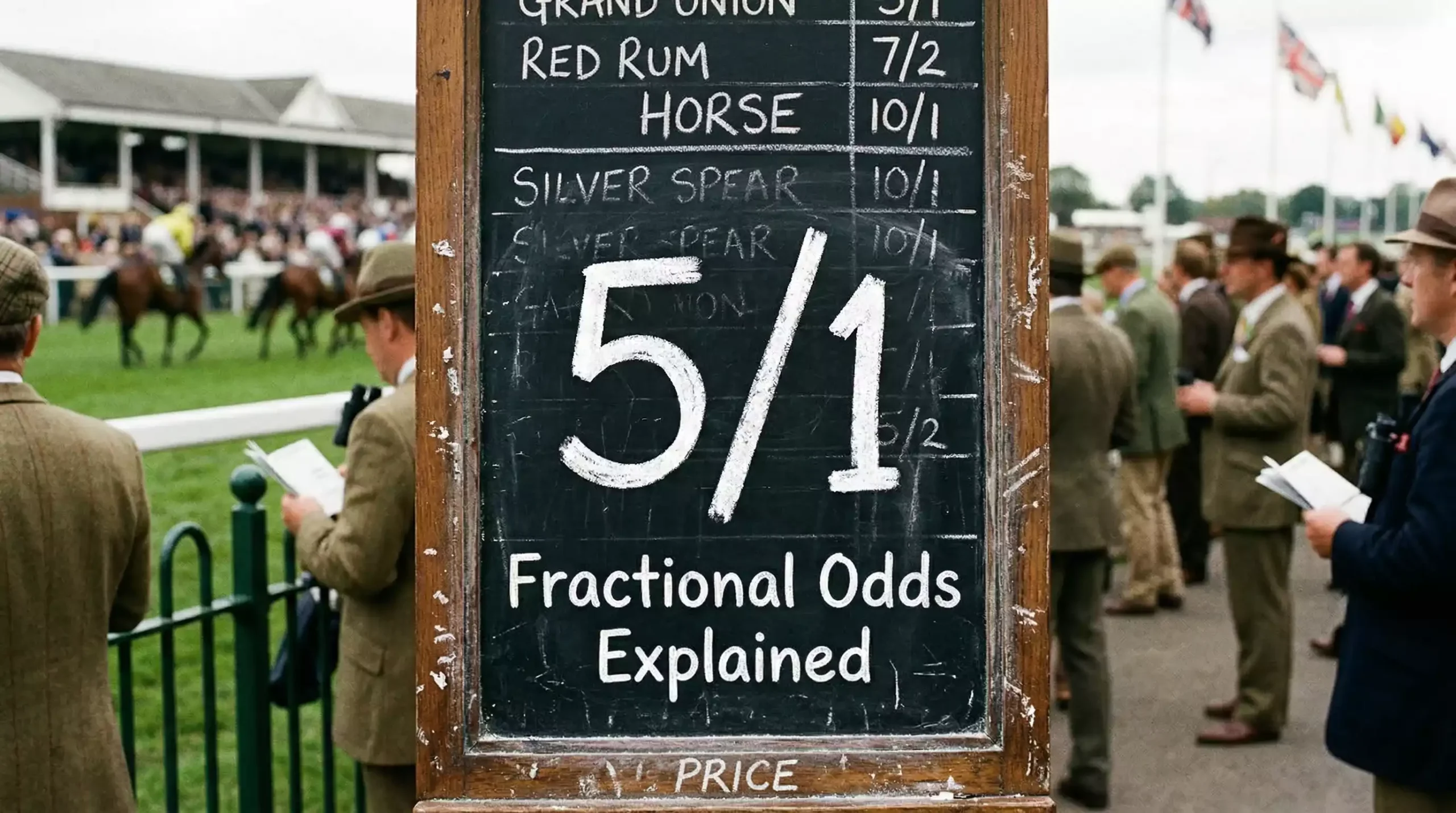
Fractional odds represent the traditional British format for expressing betting prices. When you see 5/1, 7/2, or 11/4 on a race card or betting screen, you are looking at fractional odds that tell you the profit to stake relationship. Master this format, and you can quickly assess any price at any British racecourse or bookmaker.
The format directly expresses potential profit relative to your stake. At 5/1, you profit five units for every one unit staked. At 7/2, you profit seven units for every two staked. This profit-to-stake relationship gives fractional odds their intuitive appeal for punters who think in terms of return on investment.
The TBA/PwC Economic Impact Study shows that the United Kingdom ranks third globally for top-rated races under LONGINES/IFHA rankings, with 17% of the world’s top-rated horses training in Britain. This prestigious racing industry has used fractional odds for centuries, creating a tradition that endures even as decimal formats gain ground elsewhere. As the BHA notes, millions enjoy betting responsibly on horse racing, and understanding fractional odds remains essential for participating fully in this national pastime.
Fractional Odds Explained — More on this topic at horse racing bet calculator.
Reading Fractional Odds
Fractional odds display as two numbers separated by a slash: the numerator (top/left number) and denominator (bottom/right number). The numerator represents profit while the denominator represents stake. At 4/1, spoken as “four to one,” you profit £4 for every £1 staked.
The relationship scales proportionally. At 4/1, staking £10 profits £40. Staking £25 profits £100. The ratio remains constant regardless of stake size. This consistency makes fractional odds straightforward once you grasp the underlying principle.
Non-standard fractions like 11/4 or 9/2 follow identical logic. At 11/4, you profit £11 for every £4 staked. Scaling up: £8 stake profits £22. £20 stake profits £55. The calculation multiplies your stake by the fraction to find profit.
Spoken odds use “to” between numbers. 5/1 is “five to one.” 7/2 is “seven to two.” 11/4 is “eleven to four.” At racecourses and in betting shops, you will hear these phrases constantly. Familiarise yourself with how common odds sound as well as how they appear.
Remember that fractional odds show profit only, not total return. At 5/1, a £10 stake profits £50, but your total return is £60 because you also receive your original £10 stake back. This distinction matters when comparing to decimal odds, which include the returned stake.
Odds-On vs Odds-Against
Odds-against prices have numerators larger than denominators: 5/1, 3/1, 7/4, 6/4. These selections are considered less likely to win than lose. You profit more than you stake if successful, compensating for lower win probability.
Odds-on prices have denominators larger than numerators: 1/2, 4/6, 4/5, 1/3. These selections are considered more likely to win than lose. You profit less than you stake because the higher win probability reduces the reward needed to attract bets.
Evens (1/1) sits exactly between odds-on and odds-against. At evens, you profit exactly what you stake: £10 returns £20 total. The market considers this outcome roughly 50% likely, though bookmaker margins mean true probability is slightly lower.
Odds-on prices require careful evaluation. At 1/2, you stake £2 to profit £1. Your £10 bet profits just £5 for total return of £15. The low returns mean losses hit proportionally harder. Backing a 1/2 shot that loses costs your full stake while winning recovers only half your outlay in profit.
Strong favourites often trade odds-on. A dominant horse in a weak field might be 1/4, implying roughly 80% win probability. While such selections win frequently, the occasional loss devastates because you need multiple wins to recover one defeat. Value-focused punters often avoid very short odds-on prices entirely.
Calculating Returns
Calculate profit by multiplying stake by the fraction. At 7/2, a £10 stake gives: £10 × (7/2) = £10 × 3.5 = £35 profit. Add your stake back for total return: £35 + £10 = £45.
For whole number odds like 5/1, simply multiply. £10 × 5 = £50 profit. Total return: £60.
For odds-on, the calculation inverts your intuition. At 1/2, a £10 stake gives: £10 × (1/2) = £5 profit. Total return: £15. Your stake exceeds your profit because the market rates this horse likely to win.
Complex fractions require care. At 11/8, a £16 stake gives: £16 × (11/8) = £22 profit. Notice that using a stake divisible by the denominator simplifies calculation. £8 at 11/8 profits exactly £11. £24 at 11/8 profits £33.
Each way calculations apply the fraction to place terms. If your horse is 10/1 each way with 1/4 place terms, the place odds are 10/4 = 5/2. A £5 each way bet totals £10 staked: £5 to win at 10/1, £5 to place at 5/2. If the horse places without winning: £5 × 2.5 = £12.50 profit, minus £5 lost win stake = £7.50 net profit.
Our calculator handles all these scenarios automatically, but understanding the underlying mathematics helps you quickly assess value at the track or on screen.
Common Fractional Odds
Certain fractional prices appear constantly in British racing. Memorising these common odds and their implications speeds up race card analysis considerably.
Long shots: 20/1, 25/1, 33/1, 50/1, 100/1. These outsiders rarely win but offer substantial returns when they do. 20/1 implies roughly 5% win probability. 100/1 implies under 1%.
Mid-range prices: 5/1, 6/1, 7/1, 8/1, 10/1. Competitive handicap runners often sit in this range. 5/1 implies about 17%. 10/1 implies about 9%. These prices balance meaningful win chances against attractive returns.
Shorter prices: 5/2, 3/1, 7/2, 4/1. Second and third favourites typically trade here. 5/2 implies about 29%. 4/1 implies 20%. Returns remain attractive while win probability increases.
Favourites: Evens, 6/4, 7/4, 2/1, 9/4. Market leaders occupy these slots. Evens implies 50%. 6/4 implies 40%. 2/1 implies 33%. High win rates but proportionally lower returns.
Strong favourites: 1/2, 4/6, 4/5, 10/11. Dominant selections in weak fields. 1/2 implies 67%. 4/5 implies 56%. Frequently successful but losses sting because recovery requires multiple wins.
Why UK Uses Fractional
Fractional odds predate organised bookmaking. When horse racing became a betting sport in 18th century England, odds naturally expressed the relationship between potential profit and required stake. This format aligned with how wagers were settled: you handed over your stake and received your profit (plus stake return) if successful.
Tradition preserved the format even as alternatives emerged. Continental Europe adopted decimal odds, which gained popularity through betting exchanges in the digital era. American sports betting developed moneyline odds centred on the $100 baseline. Yet British racing retained fractional odds because racecourse culture, betting shop traditions, and racing media all reinforced the format.
Practical advantages support continued use. Fractional odds show profit directly, matching how punters naturally think about returns. At 7/2, you know immediately that a £10 bet profits £35. Decimal 4.5 requires the additional step of subtracting your stake to find profit. For quick mental calculations at the track, fractional proves convenient.
The format faces gradual displacement nonetheless. Betting exchanges use decimal exclusively. International customers expect decimal or American formats. Younger punters who learned to bet online may find fractional less intuitive. Most UK bookmakers now offer format switching, letting customers choose their preference.
Understanding fractional odds remains essential for engaging with British racing culture, even if you prefer working in decimal for actual calculations. The format connects you to centuries of racing history while providing direct profit visibility.
See also Decimal Odds Explained.
